 |
| Sun Setting Over a Lake |
Thursday, June 30, 2011

John Ashbery - Two Poems

The Painter
Sitting between the sea and the buildings
He enjoyed painting the sea’s portrait.
But just as children imagine a prayer
Is merely silence, he expected his subject
To rush up the sand, and, seizing a brush,
Plaster its own portrait on the canvas.
So there was never any paint on his canvas
Until the people who lived in the buildings
Put him to work: “Try using the brush
As a means to an end. Select, for a portrait,
Something less angry and large, and more subject
To a painter’s moods, or, perhaps, to a prayer.”
How could he explain to them his prayer
That nature, not art, might usurp the canvas?
He chose his wife for a new subject,
Making her vast, like ruined buildings,
As if, forgetting itself, the portrait
Had expressed itself without a brush.
Slightly encouraged, he dipped his brush
In the sea, murmuring a heartfelt prayer:
“My soul, when I paint this next portrait
Let it be you who wrecks the canvas.”
The news spread like wildfire through the buildings:
He had gone back to the sea for his subject.
Imagine a painter crucified by his subject!
Too exhausted even to lift his brush,
He provoked some artists leaning from the buildings
To malicious mirth: “We haven’t a prayer
Now, of putting ourselves on canvas,
Or getting the sea to sit for a portrait!”
Others declared it a self-portrait.
Finally all indications of a subject
Began to fade, leaving the canvas
Perfectly white. He put down the brush.
At once a howl, that was also a prayer,
Arose from the overcrowded buildings.
They tossed him, the portrait, from the tallest of the buildings;
And the sea devoured the canvas and the brush
As though his subject had decided to remain a prayer.
Just Walking Around
What name do I have for you?
Certainly there is not name for you
In the sense that the stars have names
That somehow fit them. Just walking around,
An object of curiosity to some,
But you are too preoccupied
By the secret smudge in the back of your soul
To say much and wander around,
Smiling to yourself and others.
It gets to be kind of lonely
But at the same time off-putting.
Counterproductive, as you realize once again
That the longest way is the most efficient way,
The one that looped among islands, and
You always seemed to be traveling in a circle.
And now that the end is near
The segments of the trip swing open like an orange.
There is light in there and mystery and food.
Come see it.
Come not for me but it.
But if I am still there, grant that we may see each other.
More at:
http://www.poetryfoundation.org/bio/john-ashbery
Louise Gluck - Three Poems

First Memory
Long ago, I was wounded. I lived
to revenge myself
against my father, not
for what he was--
for what I was: from the beginning of time,
in childhood, I thought
that pain meant
I was not loved.
It meant I loved.
Midnight
Speak to me, aching heart: what
Ridiculous errand are you inventing for yourself
Weeping in the dark garage
With your sack of garbage: it is not your job
To take out the garbage, it is your job
To empty the dishwasher. You are showing off
Again,
Exactly as you did in childhood--where
Is your sporting side, your famous
Ironic detachment? A little moonlight hits
The broken window, a little summer moonlight,
Tender
Murmurs from the earth with its ready
Sweetnesses--
Is this the way you communicate
With your husband, not answering
When he calls, or is this the way the heart
Behaves when it grieves: it wants to be
Alone with the garbage? If I were you,
I'd think ahead. After fifteen years,
His voice could be getting tired; some night
If you don't answer, someone else will answer.
Humidifier
—After Robert Pinsky
Defier of closed space, such as the head, opener
Of the sealed passageways, so that
Sunlight entering the nose can once again
Exit the ear, vaporizer, mist machine, whose
Soft hiss sounds like another human being
But less erratic, more stable, or, if not like a human being,
Carried by one, by my mother to the sick chamber
Of my childhood — as Freud said,
Why are you always sick, Louise? his cigar
Confusing mist with smoke, interfering
With healing—Embodied
Summoner of these ghosts, white plastic tub with your elegant
Clear tub, the water sanitized by boiling,
Sterile, odorless,
In my mother’s absence
Run by me, the one machine
I understand: what
Would life be if we could not buy
Objects to care for us
And bear them home, away from the druggists’ pity,
If we could not carry in our own arms
Alms, alchemy, to the safety of our bedrooms,
If there were no more
Sounds in the night, continuous
Hush, hush of warm steam, not
Like human breath though regular, if there were nothing in the world
More hopeful than the self,
Soothing it, wishing it well.
More at:
http://www.poetryfoundation.org/bio/louise-gluck
Tuesday, June 28, 2011
Three Poems by Hsia Yü

To Be Elsewhere
We met in a coastal village
spent a lovely night without leaving an address
going separate ways. Three years later
we meet again by coincidence.
The whole
three years spun a novel
we abandoned:
They fail to recognize themselves
as though meeting in another story
for an encounter.
One asks: Who are you, so cold and weary
The other says: I only know a thread is loose on my sweater
The more you pull it, the more it lengthens
until I completely vanish.
-- Source: Poetry (June 2011)
TRANSLATED FROM THE CHINESE BY KAREN AN-HWEI LEE
Cinema Is Superseding the Gaze
All you have to do is find yourself some amateur actors
And a bargain-basement video cam
That can film in natural light and ambient sound
Your actors don’t even have to act
In fact you’re better off
If they just glance now and then at the camera
And move around a bit
Exchanging the occasional line of conversation
We have all the time in the world
For we’re making a road movie
And it should be pretty good
Turns out one of the actors is seriously narcoleptic
Which is why we have this baby alarm
— from Poetry Now 10, translated by Steve Bradbury
The Saw
I visualize you walking on the other side from me
In our scanty understanding of the universe
We propose a simple definition
Which we call “the time difference”
Whenever I feel delicious or defeated
In the watery regions of the night
We author our “form and meter”
Like the cardinal principles
Certain schools of painting have long advanced
Pressing myself against the dark
I continue my contemplation of a kind of saw-tooth-shaped truth
I engage in the contemplation
Of serration
An opened can for instance
My contemplation of the can goes thus:
The opening of a can turns
Upon a kind of saw-tooth-shaped truth
I contemplate but then I sleep
Sleep being an ancient practice
Older than civilization
Older yet than poetry
I sit and puzzle over it for hours
Resolved to not resist it
I contemplate sleep
When like a saw
I drag myself awake
I contemplate the saw
-- From the Chinese by Steve Bradbury
From the collection FUSION KITSCH
Monday, June 27, 2011
The Art of Jean-Michel Basquiat

Trailer for the film The Radiant Child directed by Tamra Davis
Cadillac Moon

Electric Chair

Slave Auction

Dos Cabezas

Trumpet
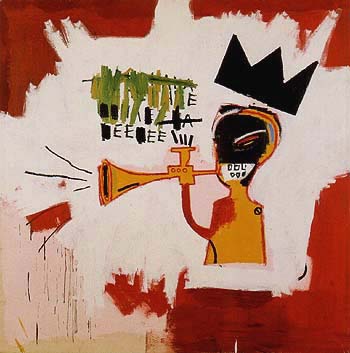
Untitled

Arroz Con Pollo

Saturday, June 25, 2011
Three Poems by Wallace Stevens (1879-1955)
 |
| Wallace Stevens |
Study of Two Pears
I
Opusculum paedagogum.
The pears are not viols,
Nudes or bottles.
They resemble nothing else.
II
They are yellow forms
Composed of curves
Bulging toward the base.
They are touched red.
III
They are not flat surfaces
Having curved outlines.
They are round
Tapering toward the top.
IV
In the way they are modelled
There are bits of blue.
A hard dry leaf hangs
From the stem.
V
The yellow glistens.
It glistens with various yellows,
Citrons, oranges and greens
Flowering over the skin.
VI
The shadows of the pears
Are blobs on the green cloth.
The pears are not seen
As the observer wills.
Six Significant Landscapes
I
An old man sits
In the shadow of a pine tree
In China.
He sees larkspur,
Blue and white,
At the edge of the shadow,
Move in the wind.
His beard moves in the wind.
The pine tree moves in the wind.
Thus water flows
Over weeds.
II
The night is of the colour
Of a woman's arm:
Night, the female,
Obscure,
Fragrant and supple,
Conceals herself.
A pool shines,
Like a bracelet
Shaken in a dance.
III
I measure myself
Against a tall tree.
I find that I am much taller,
For I reach right up to the sun,
With my eye;
And I reach to the shore of the sea
With my ear.
Nevertheless, I dislike
The way ants crawl
In and out of my shadow.
IV
When my dream was near the moon,
The white folds of its gown
Filled with yellow light.
The soles of its feet
Grew red.
Its hair filled
With certain blue crystallizations
From stars,
Not far off.
V
Not all the knives of the lamp-posts,
Nor the chisels of the long streets,
Nor the mallets of the domes
And high towers,
Can carve
What one star can carve,
Shining through the grape-leaves.
VI
Rationalists, wearing square hats,
Think, in square rooms,
Looking at the floor,
Looking at the ceiling.
They confine themselves
To right-angled triangles.
If they tried rhomboids,
Cones, waving lines, ellipses --
As, for example, the ellipse of the half-moon --
Rationalists would wear sombreros.
Domination of Black
At night, by the fire,
The colors of the bushes
And of the fallen leaves,
Repeating themselves,
Turned in the room,
Like the leaves themselves
Turning in the wind.
Yes: but the color of the heavy hemlocks
Came striding.
And I remembered the cry of the peacocks.
The colors of their tails
Were like the leaves themselves
Turning in the wind,
In the twilight wind.
They swept over the room,
Just as they flew from the boughs of the hemlocks
Down to the ground.
I heard them cry -- the peacocks.
Was it a cry against the twilight
Or against the leaves themselves
Turning in the wind,
Turning as the flames
Turned in the fire,
Turning as the tails of the peacocks
Turned in the loud fire,
Loud as the hemlocks
Full of the cry of the peacocks?
Or was it a cry against the hemlocks?
Out of the window,
I saw how the planets gathered
Like the leaves themselves
Turning in the wind.
I saw how the night came,
Came striding like the color of the heavy hemlocks
I felt afraid.
And I remembered the cry of the peacocks.
Friday, June 24, 2011
Ernst Kirchner (1880-1938)
 |
| Ernst Kirchner |
"A painter paints the appearance of things, not their objective correctness, in fact he creates new appearances of things."
Dancers in Red

Naked Playing People

Cafe Garden

Nude with Japanese Parasol

Tavern

Sitting Woman

More at:
Subscribe to:
Posts (Atom)